الاثنين، 28 مارس 2011

Euro Rally: Temporary or Permanent

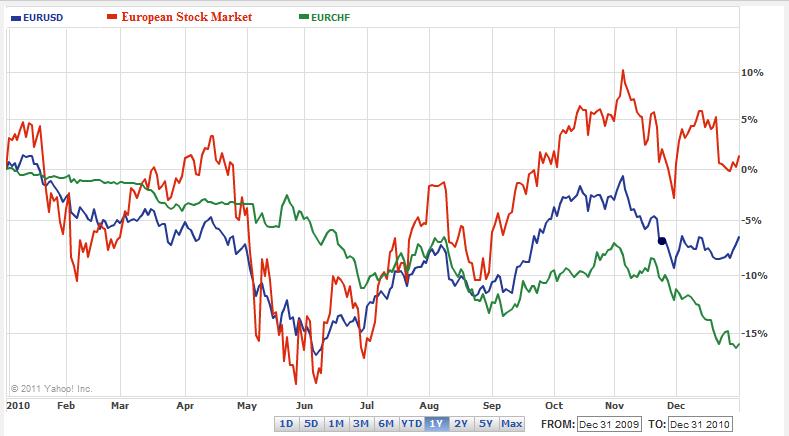
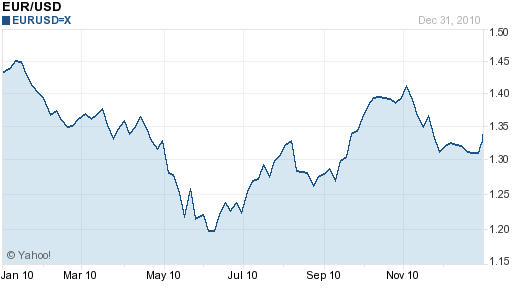
Since the beginning of June, the Euro has rallied by an impressive 8% against the US Dollar, and by comparable margins against other currencies. The question on every one’s minds, of course, is whether this represents a temporary pullback or a permanent correction.
EUR USD 3 months 2010
The arguments in favor of the former are pretty strong. Namely, EUR/USD bearish sentiment had expanded to such an extreme level that a pullback – temporary or permanent – was basically inevitable. From this standpoint, what we have seen unfold over the last month-and-a-half is a classic short squeeze. Basically, those who were short the Euro were forced to cover their positions when it started to rally, which in turn triggered more selling, and ultimately, a self-fulfilling rally. As a result, “The difference in the number of wagers by hedge funds and other large speculators on a decline in the euro compared with those on a gain dropped to 38,909 on July 6, compared with record net shorts of 113,890 on May 11.”
Due to its sudden rise, the Euro became a much less attractive funding currency for carry traders. It helps that other Central Banks are delaying interest rate hikes, which means it’s difficult to turn a solid profit (on a risk-adjusted basis) from shorting the Euro. In addition, the markets have started to turn their attention to economic fundamentals in the US, which had been edging out the Euro in one of the perennially important rivalries in currency markets. In short, it suddenly became obvious to traders that the economic and fiscal conditions in the US are at best equal to those in the EU.
Finally, there was an implicit acknowledgement among the EU leadership that the so-called sovereign debt crisis is actually in many ways a banking crisis. This admission came in the form of stress-tests on 91 of the EU’s largest banks, designed to determine their exposure to sovereign debt and placate investors. After all,  “It was German and French banks that led the way in lending to Greece or Spain.” This misjudgement has spurred such banks to set aside Billions in potential losses and vastly curtail their lending activities.
Unfortunately, investors are skeptical that the stress tests will be stringent enough, seeing them as a mere publicity stunt: “While the EU have tried to counter these suspicions by promising to publish the result of stress tests, the market is fearful that stress tests will force some banks into writing down losses on non-performing loans.” By extension, investors are still equally concerned about the possibility of a sovereign debt default, even one that it is only partial.
In other words, the consensus is that despite the EU’s best efforts to tackle the crisis, it still has yet to enact meaningful structural reforms, opting instead for short-term stopgap solutions. According to The Economist, “The debate about how to save Europe’s single currency from disintegration is stuck…because the euro zone’s dominant powers, France and Germany, agree on the need for greater harmonisation within the euro zone, but disagree about what to harmonise.” There remains a lack of agreement over whether the economically and fiscally weaker members of the EU will be allowed to remain members, and if so, what if anything will be done to keep them in line.
EU Public Debt
As you can see from the chart above, time is quickly running out. For the majority of EU countries, debt is now rising faster than GDP. From the standpoint of many investors, default seems like the most likely outcome since such countries lack the political muster to reduce their budget deficits, nor can they devalue their debt  through currency depreciation, due to the common currency.
Thus, the consensus (for now) is that the Euro’s run will soon come to an end. According to Citigroup, “The euro will resume its decline and head toward the $1.10-$1.15 range. ‘The market has digested a lot of the bad news about the euro. There’s no great optimism.’ ” Meanwhile, BNP Paribas “expects the euro to fall to parity by the end of 2010—one euro per dollar—a level it hasn’t seen since December 2002…[and] drift to 97 cents before hitting bottom in the third quarter of 2011.
Read more ....

Bullish on the Euro

Wouldn’t life just be a little easier if the EUR/USD, the most important forex pair and bellwether of currency markets, could simply pick a direction and stick to it. It dove during the financial crisis, only to surge during the apparent recovery phase, fell during the sovereign debt crisis, and rose during the paradigm shift, then fell as risk appetite waned, only to rise again in September, en route to a 5-month high.
Euro Dollar 5 Year Chart 2006-2010
There are a handful of factors which currently underlie the Euro’s strength, which can all generally be explained by the fact that risk is “on” at the moment, and the markets are moving away from so-called safe haven currencies and back towards growth investments. Of course that could change tomorrow (or even 5 minutes from now!), but at the moment, risk appetite is high and the Euro symbolizes risk. Never mind how ironic it is, that growth in the EU is projected at 1.8% for the year while Rest of World (ROW) GDP will probably top 5%. All that matters is compared to the Dollar (and Yen, Pound, Franc to a lesser extent) the Euro is perceived as the currency of risk.
The Euro’s cause is also helped by the ongoing “currency wars,” which heated up last week with Japan’s entry into the game. Basically, Central Banks around the world are now competing with each other to devalue their currencies. In contrast, the European Central Bank (ECB) has decided to remain on the sidelines (in favor of fiscal austerity), which is forcing the Euro up (or rather all other currencies down). To make matters even worse, “The U.S. Federal Reserve indicated this summer that it may ease monetary policy further… often seen as printing money to pump up the economy.” As a result, “The euro looks set to keep on climbing in a trend that looks increasingly entrenched.”
There are certainly those that argue that the Euro’s recent surge reflects renewed confidence in the Eurozone economy and prospects for resolving the EU debt crisis. After all, most Euro members will reduce their budget deficits in 2010 and auctions of new bonds are once again oversubscribed. On the other hand, interest rates for the PIGS (Portugal, Italy, Greece, and Spain) have risen to multi-year highs, as investors are finally trying to make a serious effort at pricing the possibility of default.
Eurozone sovereign debt interest rates graph 2007-2010
In addition, the credit markets in the EU are barely functioning, and large institutions remain dependent on the ECB’s credit facilities for financing. Finally, it shouldn’t be forgotten that the only reason crisis was due to the massive support (€140 Billion) extended to Greece. When this program expires in less than three years, the fiscal problems of Greece (and the other PIGS) will be exposed once again, and a new (stopgap) solution will need to be proposed.
As every analyst has pointed out, none of the EU’s fiscal problems have been solved. EU members have certainly proven adept at resolving acute crises and the ECB certainly deserves credit for keeping credit markets functioning, but none has proposed a viable solution for repairing of member countries’ fiscal and economic health. Currency devaluation is impossible. Sovereign default is being prevented. That leaves wage cuts and increased productivity as the only two paths to equilibrium. The former could be accomplished through inflation, but the ECB seems reluctant to allow this to happen.
Eurozone Budget Deficits, GDP
For better or worse, the EU seems to have pushed these problems down the road, and if all goes according to plan, they won’t need to be revisited for 2-3 years. For now, then, the Euro is probably safe, and may even thrive. Short positions in the Euro are being unwound with furious speed and data indicate that there is still plenty of scope for further unwinding. Inflation remains subdued, economic growth is stable, and the ECB so far hasn’t voiced any disapproval of the Euro’s rise. While I promote this bullishness with the caveat that “traders have shown a willingness to smack the euro lower from time to time on the slightest news or rumor of downgrades to euro-zone sovereign or bank ratings,” the general Euro trend is now unquestionably UP.
Read more ....

Euro Due for a Correction

Since touching a four-year low in June, the Euro has risen a whopping 19% against the Dollar – a veritable surge! One has to wonder, however, if perhaps the Euro hasn’t gotten ahead of itself in its race back upward.
The Euro’s nonstop rise has perplexed me. During the throes of the Eurozone Sovereign debt crisis, it seemed as if the Euro was headed back towards parity, if it even remained in existence! The European Commission’s $500 Billion bailout plan seemed to assuage the markets, but didn’t do much to mitigate against the risk of sovereign default. Besides, it looks like all of the austerity measures will be undone after the next election cycle. Opposition to further budgets is so vehement, and unemployment is so high (12% in Greece, 20% in Spain) that it will be difficult for leaders to stay in office if they continue to push an agenda that reduces their deficits.
Euro Dollar 1 Year Chart
As evidence that bond investors remain skeptical, consider that Greek debt still trades at a 700 basis point premium to German bonds. EU cheerleaders love to point to the fact that at-risk Eurozone countries are having no trouble tapping the credit markets, but that’s not really surprising when you consider the lofty returns that investors receive for buying bonds that are essentially backed by the good credit of the EU.
Even ignoring the fiscal problems of the EU, the economic picture is not pretty. “The Economist Intelligence Unit, in its just-released report…is forecasting that growth in Western Europe will reach only 1.1% next year, and at or below 1.7% at least through 2015, beyond which it wisely declines to look.” When you subtract out Germany – the engine of the EU economy -  GDP growth will be even more pathetic. And don’t even mention the peripheral economies, many of which are at serious risk for sliding back into recession.
Moreover, the European Central Bank (ECB) monetary policy is just as loose as in other industrialized countries. Through its quantitative easing program, the ECB has injected hundreds of billions of Euros into the banking system and credit markets. Jean Claude Trichet, President of the ECB, bristled at the idea of ending this support: “No! This is not the position of the Governing Council, with an overwhelming majority.This non-standard measure…was designed to help restore a more normal functioning of our monetary policy transmission mechanism.”
On the other hand, the ECB is sterilizing all of its market intervention, which means that most of the funds that it is injected into the economy will remain in the EU. Contrast this with the Fed’s quantitative easing program (which hasn’t been sterilized) and you begin to understand why the Euro has held up well. In addition, Eurozone inflation currently exceeds US inflation (at a 50-year low), which means that the ECB will hesitate before following the Fed in easing monetary policy further.
Still, I don’t think there is a strong foundation for the Euro’s rise. It’s understandable that the expansion of the Fed’s quantitative easing program (“QE2″) is making investors nervous, causing them to send cash out of the US as a preventative measure. However, this seems a little too much like the tail wagging the dog, since until QE2 is officially implemented, all anticipatory shifts in capital flows are purely speculative – not fundamental. And as a fundamental analyst, that concerns me.
I think investors got ahead of themselves when they pushed the Euro down 20% over the first half of 2010, but now they are in danger of making the same mistake, and are pushing the Euro too far in the opposite direction. According to the most recent Commitment of Traders report, investors are building up long positions in the Euro, to the point that trading is becoming lopsided. I’m not much for short-term technical analysis, but when the Relative Strength Index (RSI) and Moving Average Convergence Divergence (MACD) are both approaching 2-year highs, it tells me that a correction is coming.
Read more ....

Euro Correction is Here

You can think of this as a follow-up to my last post, entitled “Euro Due for a Correction,” in which I proclaimed that “investors got ahead of themselves when they pushed the Euro down 20% over the first half of 2010, but now they are in danger of making the same mistake, and are pushing the Euro too far in the opposite direction.” Since then, the Euro has indeed fallen 4%. In this case, however, I’m reluctant to toot my own horn, since there were other forces at work.
Euro USD 3 Month ChartNamely, he sovereign debt crisis has officially spread beyond Greece, and “Contagion is definitely back on the table.”  Of chief concern is Ireland, whose banking sector is in serious financial turmoil: “Irish banking losses are estimated at up to 80 billion euros ($109 billion), depending on the forecast used, or 50 percent of the economy. As long as housing prices continue to fall, these losses cannot be capped.” At this point, it’s unlikely that the banks can remain afloat without (additional) government help. The only problem is that the government has already raided its welfare fund, and it is projected that additional support would leave a gaping hole in the budget, equivalent to 32% in GDP. Allowing the banks to fail, meanwhile, would lead to economic losses of 50% of GDP.
Portugal and Spain (rounding out the so-called PIGS countries) are also in trouble, with budget deficits of around 9% of GDP. Given that both countries are struggling economically, it is possible that austerity measures and budget cuts could backfire and worsen their respective fiscal situations. Like their Irish counterparts, Portuguese banks remain heavily reliant on access to cheap ECB credit in order to function. Spanish banks, meanwhile are plagued by distressed loans, which account for “5.6 percent of total Spanish bank loans — the highest level since 1996.”
Currently, their governments insist that they can get by without help from the European Commission. To be fair, they have managed both to issue new debt and refinance existing debt without serious difficulty. In addition, Ireland and Portugal have modest reserve funds which could tide them over for close to a year, if need be. The medium-term, however, looks less rosy.
Ireland Portufal Bond Yields 2010 - Sovereign Debt Crisis
If rising bond yields are any indication, these countries could be in serious trouble. Bond investors are not concerned about an EU bailout, which is seen as inevitable, at least for Ireland. After all, the European Financial Stability Facility that was created in May still has more than $500 Billion left in it. Rather, investors are concerned that they will be asked to take part in the bailout.
Germany, for example, is toughening its stance towards fiscally strained countries, and Angela Merkel has insisted that, “Highly indebted eurozone countries struggling to repay will be forced to restructure their debt in a process of ‘managed insolvency’ and that their creditors will need to take large ‘haircuts.’ ” Up until now, the EU has intimated that will provide a backstop against sovereign default, in order to assuage bond market investors.
This is changing, as German and French politicians insist that they are more beholden to their constituents/taxpayers than they are to their debt-ridden EU brethren.  Given that Germany is fiscally sound, it has pretty much nothing to lose (short of a breakup of the Euro) by playing hardball. In fact, it may actually benefit from scaring away investors, since a weaker Euro will strengthen its export sector.
Going forward, it seems safe to say that the Euro correction will continue, as investors continue to reevaluate their exposure to sovereign credit risk. According to the most recent CFTC Commitments of Traders report, “Investors last week slashed their bets in favor of the euro by 40% to a level not seen since early October.” Of course, given that the Dollar is plagued by its own set of problems, it’s unclear whether the EUR/USD will experience serious fluctuations. Against other currencies, however, the Euro will probably decline: “Those who want to go short euro should consider doing it on the crosses.”
Read more ....

Euro-Watchers Pull About-Face

Only last month, the Euro was on top of the forex markets. Especially relative to its “G4″ competitors (Dollar, Yen, Pound) – all of which are plagued by economic uncertainty and loose monetary policies – the Euro was seen as a smart bet. In the last few weeks, however, the EU sovereign debt crisis resurfaced, and the Euro has plunged, losing 7.5% of its value against the Dollar. As a result, investors have pulled an about-face: instead of banking on the European Central Bank (ECB) to buoy the Euro through monetary restraint, they are now counting on it to hold the Euro together by adopting the same tactics as its counterparts.
Before I explain what I mean here, I’d like to offer an update on the EU fiscal situation. In the last week, there were a handful of developments. First, Ireland accepted a tentative €85 Billion in aid from the EU/IMF, officially joining the ranks of an infamous club that also includes Greece. Still, it wasn’t clear whether such a bailout would also include Irish banks, which are seen as perhaps in deeper trouble than the Irish government. As a result, investors were unmoved, and S&P moved ahead with a cut to Ireland’s sovereign credit rating.
Ireland Public Deficit of GDP
Naturally, rumors began to circulate that Portugal was also preparing a formal bailout request. Said one trader, “In Portugal the kind of language you’re hearing is similar to what you heard in Ireland a few weeks ago.” Despite promises to the contrary, Portugal’s budget deficit has widened in 2010. Interest in its most recent bond issue was healthy, but at the highest interest rate since the Euro was introduced in 1999 and more than .5% higher than last month.
Ultimately, bailouts of Greece, Ireland, and Portugal can be managed. It is a default and/or preemptive rescue of Spain – the other PIGS member – that worries investors. Its economy represents more than 11% of the EU and any hiccup would seriously shake the foundations of the Euro: “It may well be that we are approaching the endgame of this part of the crisis as Spain is of such importance that one can only imagine that the EU will regard it as the line in the sand that cannot be crossed.” While Spain is working hard to cut its budget deficit to a still-stratospheric 9.3% in 2010, investors have balked. As a result, interest rates in its bonds have surged to a post-Euro high (relative to German bonds), and credit default swap spreads (which insure against the risk of default) have risen substantially.
The problem with the EU sovereign debt crisis – like most credit crises, for that matter – is that they tend to be self-fulfilling. As investors begin to doubt the ability of institutions (governmental and otherwise) to service their debts, they naturally demand greater compensation for the (perceived) increase in risk. This further inhibits that institution’s ability to repay its loans, which only makes funding more difficult to attract, and so on.
It is ironic on multiple levels then that even as investors abandon the debt of EU member countries, they are hoping that the ECB steps in to fill the void they create. As I alluded to the title of this post, this marks a stunning about-face from only a few months ago, when the Euro was rising against the Dollar because of the ECB’s commitment to a responsible monetary policy. Nowadays, the Euro rallies only on news that the ECB is maintaining or expanding its intervention. For example, the Irish banking sector is “increasingly more reliant on the ECB funding,” and as a result, “The euro edged up…as the European Central Bank continued buying Portuguese and Irish government bonds.”
Based on this change in investor mentality, it seems unlikely that the Euro will recover its losses anytime soon. Of course, the ECB has nearly unlimited resources at its disposal. German central bank chief Axel Weber declared confidently that, “An attack on the euro has no chance of succeeding.” However, the ECB can never hope to fully supplant the important role played by private capital, and besides, “What we are experiencing at present is not a speculative attack but a justified depreciation due to unsolved problems.”
Euro Dollar chart December 2010
There are still plenty of optimists who believe that the fear will soon die down and that higher interest rates will attract some of the yield-hungry investors that are currently focused on emerging markets. Goldman Sachs forecast “the euro will rise to $1.50 by year-end 2011 as big economies in the area continue expanding.”
I think the most realistic assessment is somewhere in between. On the one hand, it seems unlikely that the Spain will default on its debt at anytime in the near future or that the Euro will cease to exist. On the other hand, the fact that investors now see the ECB as a savior for following in the footsteps of the Fed implies that there is no reason for investors to buy the Euro against the US Dollar.
Read more ....

Euro: Which Investors Know Best?

As the WSJ recently pointed out, there is a bizarre disconnect between equities and currency markets regarding the Euro. On the one hand, the Euro was the world’s worst performing major currency in 2010, and some analysts insist that its breakup is inevitable. On the other hand, stock market investors are increasingly bullish about Europe: “We remain positive on the outlook for [European] stocks in 2011, with a favorable macro backdrop, solid earnings and attractive valuations.” Who’s right?
In fact, both sets of investors are justified. As you would expect, stock market investors are focusing on corporate earnings and the macroeconomic environment. In this regard, the fact that the EU economy expanded in 2010 – buoyed by a cheap currency and loose monetary policy – should certainly be reflected in a stronger stock prices. On the other hand, the sovereign debt crisis in EU has not yet abated, and accordingly, it is still being priced into EUR/ exchange rates.
In the immediate short-term, it’s possible that stock market investors will prevail and that that their collective view will be adopted by currency markets. According to Deutsche Bank, “The euro may rise to $1.45 by the end of the first quarter of next year, as concerns about the single-currency area’s indebted periphery diminish.” Meanwhile, China recently pledged its support for the Euro via a promise to purchase up to €5 Billion in Portuguese Sovereign debt. Over the short-term, then, it’s possible that (currency) investors can be persuaded to temporarily forget about the prospect of default, and focus instead on the Eurozone’s nascent economic recovery.
Over the medium-term, however, the markets will have no choice but to  return their attention to the possibility of default, which is why the same team of analysts from Deutsche Bank “forecasts the euro will fall back to $1.40 by the end of the second quarter and to $1.30 by the year-end.” For example, Eurozone members will need to issue more than €500bn in debt in 2011, including €400bn that needs to be refinanced by Spain and Italy. In this context, China’s purchases will fade to the point of becoming trivial.
Meanwhile, Moody’s has warned that it could follow up on its 5-notch downgrade of Ireland’s sovereign credit rating with further downgrades for Spain and Portugal. Fitch added that it might bump Greece’s rating to junk status, which would deal a significant blow to its solvency. Default is now rapidly on course to becoming a self-fulfilling prophecy, as fleeing investors cause yields to rise and credit ratings to fall, further scaring away more investors.
The EU response has been to “set up a permanent mechanism from mid-2013,” while investors continue to push for an expansion of the European Financial Stability Facility or the joint issuance of European sovereign bonds. As a result, the Center for Economics and Business Research has issued a striking forecast that there is an 80% probability that the European Monetary Union will dissolve over the next decade: “If the euro doesn’t break up, this could be the year when it weakens substantially towards parity with the dollar.” Already, spot market traders are once again increasing their short bets for the Euro, and options trading remains “skewed toward euro puts.”
To be fair, some analysts continue to insist that it is better to think of the sovereign debt problems as a crisis of credit, rather than of currency. In that sense, there is hope that a solution can be engineered (perhaps encompassing a default) that doesn’t endanger the existence of the Euro. In addition, the Euro finished 2010 on a high note, formally welcoming Estonia into the fold. It is 10% above its June trough, including a 2% rise in the month of December. Given all of the bad news in 2010, that might just be cause for optimism.
Read more ....

Despite Recent Rise, Euro Still Looks Weak

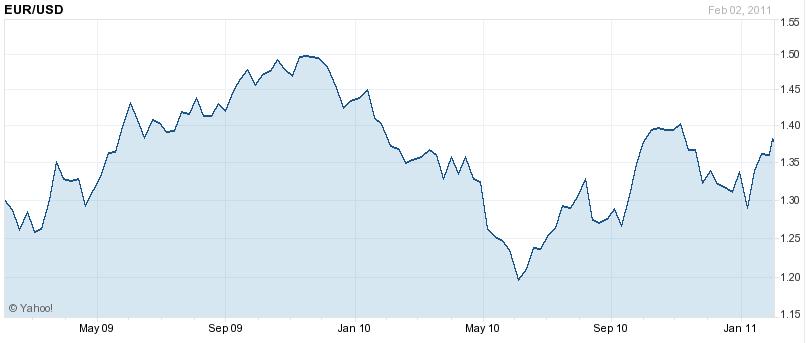
As the Euro moves past $1.38 per Dollar towards a 1-year high, many traders are wondering if perhaps the common currency’s woes aren’t in the past. This would be a mistake. That’s because most of the forces behind the Euro’s rally actually have very little to do with the Euro.
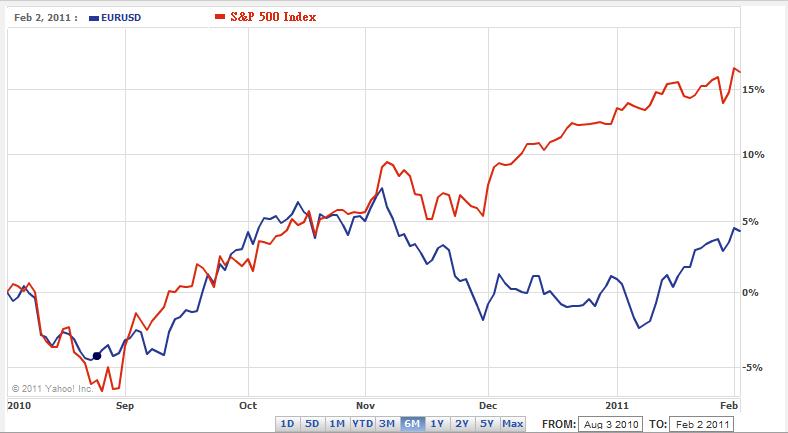
The main cause of Euro strength has been a pickup in risk appetite. Investors are becoming increasingly more confident in the prospects for global economy recovery, and the crisis mentality is rapidly fading. Ironically, the flurry of positive economic data emanating from the US has been terrible for the Dollar. You can see from the chart below that except for a gap in 2010 Q4 (due to a flareup in the EU sovereign debt crisis….more on that below), the US stock market rally has coincided with a shift away from the Dollar and towards the Euro.
In fact, the Euro still remains extremely vulnerable to the ebb and flow of investor risk tolerance. That applies not only to events endogenous tot the EU, but also to global market shocks. That means that any reminder of the Eurozone’s fiscal issues (such as last week’s downgrade of Ireland’s credit rating) is likely to be reflected in a weaker Euro. For another example, look no further than the recent political turmoil in Egypt and the wider Middle East. Summarized one analyst, “In itself, Egypt is not that big an economy. But there is some worry about the supply of oil through the Suez Canal. It does impart a negative vibe on risk.”
The Euro’s recent appreciation is also rooted in technical factors. What began as a modest rally quickly turned into a upward surge as investors moved to cover their short positions. The WSJ reported that “much of the recent rally was fueled by hedge funds and other speculative investors covering short positions…Investors are ‘not going out and buying the euro because they love it.’ ” This apparent short squeeze can be seen in the sudden and massive reversal of positions that was documented in the most recent CFTC Commitment of Traders Report.
On a related note, there are signs that Euro puts (which allow investors to hedge Euro exposure by giving them the right to sell) are unusually cheap at the moment. “Demand for euro puts, which give investors the right to sell the euro in the future, appears to be growing, relative to euro calls, which allow them to buy, analysts say. That reverses a recent trend that had investors actively selling euro puts or sitting on their hands as the euro climbed…[and] suggests investors are becoming more biased towards selling the euro.” If speculators think that the options market is mis-pricing risk, they might start buying up puts and exert downward pressure on the Euro.
The only factor which could be construed as legitimately positive for the Euro pertains to interest rate differentials. Currently, Euro rates are just as low as in the US and the rest of the G4 world. However, that could soon change. The European Central Bank (ECB) is notoriously hawkish when it comes to conducting monetary policy. If you recall, it foolishly raised its benchmark interest rate during the height of the credit crisis. With inflation already running above 2%, you can bet that it will only be a matter of time before it reacts in kind. For the sake of contrast, consider that the Fed is still in the process of easing, via QE2.
While rate hikes would certainly provide a boost for the Euro, it is unlikely that rate differentials will be wide enough to spur any serious among yield-seeker in the immediate future. In short, I think the downside risks to the Euro (which is apparently on the verge of “disintegration,” according to George Soros) far outweigh any further upside support, and I think the rally will peter out soon.
Read more ....

Pound Vs. Euro: Tie Game for Now?

hile I’m fondest of analyzing all currencies relative to the Dollar (after all, it’s what I’m most familiar with and is involved in almost half of all forex trades), sometimes its interesting to look at cross rates.
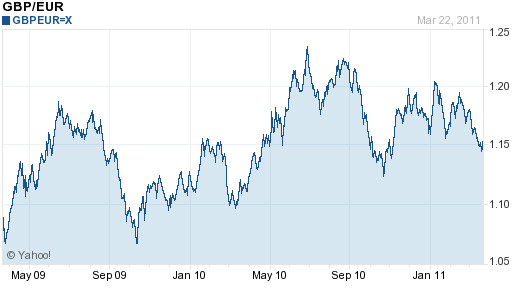
Take the Pound/Euro, for example, arguably one of the most important crosses, and one of a handful that often moves independently of the Dollar. If you chart the performance of this pair over the last two years, however, you can see the distinct lack of volatility. It has fluctuated around an axis of 1.15 GBP/EUR, never straying more than 5% in either direction. In fact, it’s sitting right at this level as I compose this post.

Yesterday, I read some commentary by Boris Schlossberg (whom I interviewed in 2010), Director of Currency Research at GFT. In the title (“Euro and Pound Go Their Separate Ways”), he seemed to suggest that a big move was imminent. Aside from noting that both currencies stand at crossroads, he declined to offer more concrete guidance on the direction of the potential breakout.
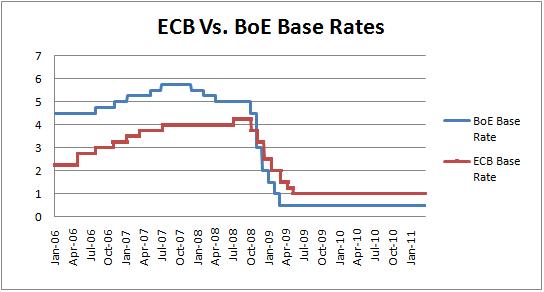
At the moment, the markets are gripped by risk aversion, caused by the Mid East political turmoil and the Japanese natural disasters. Once these events run their course and the accompanying market tension subsides, investors will need something else to latch on to. Perhaps the Bank of England (BoE) and European Central Bank (ECB) can fulfill this function, since both are on the verge of hiking their respective benchmark interest rates . Absent any other developments, the timing and speed of such hikes will probably dictate not only how these currencies perform against each other, but also how they perform against the Dollar.
Despite the numerous indications that both have given to the contrary, I don’t think either Central Bank is in a hurry to raise interest rates. Economic growth remains poor, unemployment is high, and inflation is still moderate. Neither is yet at the stage where it can unwind the monetary easing that it put in place at the height of the financial crisis. Moreover, both are wary about the potential impact of rate hikes on their respective currencies (a concern that I am ironically fomenting with this post).
It looks like the BoE will be the first to act. Combined with high energy prices, the bank’s easy monetary policy is putting extraordinary pressure on prices, and it now appears that inflation could reach 5% in 2011. In addition, the BoE voted 6-3 at its last meeting in favor of tightening, which means that a hike probably isn’t too far off. On the other hand, the ECB is talking tough, but it still doesn’t have much of an impetus to act. Inflation is moderate, and besides, the region’s banks remain too dependent on ECB cash for it to serious contemplate being aggressive.
Either way, the interest rate differential probably won’t be great enough to encourage any short-term speculation between the two currencies. In addition, I think investors will continue to look to the Yen and the Dollar for guidance, and we won’t see any significant movement in either direction. [The chart below is based on benchmark lending rates and isn't necessarily applicable for retail forex trading].

This would create two opportunities for investors: Options traders should consider a long straddle, which involves selling a put and call at the same strike price (perhaps 1.15), pocketing the premiums, and praying that the rate doesn’t fluctuate much (since they would be exposed to unlimited risk). In the future, carry traders can also profit from the lack of volatility through a carry trading strategy, perhaps amplified by a little leverage. Be careful, however. Since interest rate differentials are currently so small (The current LIBOR rate disparity is a mere .05%!) and probably won’t widen to more than 1% over the next twelve months, any profits from interest could easily be wiped out by even the smallest adverse exchange rate movements.
Read more ....

UK Forex Reserve Plan could Harm Pound

Yesterday, UK Chancellor George Osborne announced that his government was ready to begin rebuilding its foreign exchange reserves. Depending on when, how, (or even if) this program is implemented, it could have serious implications for the Pound.
Forex reserve watchers (myself included) were excited by the updated US Treasury report on foreign holdings of US Treasury securities. As the Dollar is the world’s de-facto reserve currency and the US Treasury securities are the asset of choice, the report is basically a rough sketch of both the Dollar’s global popularity and the interventions of foreign Central Banks. Personally, I thought the biggest shocker was not that China’s Treasury holdings are $300 Billion greater than previously believed (with $3 Trillion in reserves, that’s really just a rounding error), but rather that the UK’s holdings declined by 50% in 2010, to a mere $260 Billion.

Given that the Bank of England (BoE) injected more than $500 Billion into the UK money supply in 2010, I suppose that shouldn’t have been much of a revelation. After all, selling US Treasury Securities and using the proceeds to buy British Gilts (sovereign debt) and other financial instruments would enable the BoE to achieve its objective without having to resort to wholesale money printing. In addition, if not for this sleight of hand, UK inflation would probably be even higher.
Still, this is little more than a mere accounting trick, and those funds will probably still need to be withdrawn from the money supply at some point anyway. Whether the BoE burns the proceeds or reinvests them back into foreign instruments is certainly worth pondering, but insofar as it won’t impact inflation, it is a matter of economic policy, and not monetary policy.
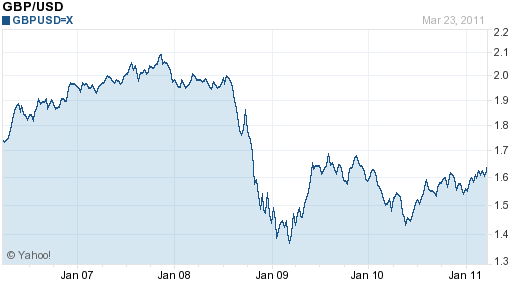
As Chancellor Osborn indicated, the UK will probably send these funds back abroad. In addition to providing support for the Dollar (as well as another reason not to be nervous about the upcoming end of the Fed’s QE2), this would seriously weaken the Pound, at a time  that it is already near a 30-year low on a trade-weighted basis. After falling off a cliff in 2009, the Pound recovered against the Dollar in 2010, largely due to the BoE’s shuffling of its foreign exchange reserves. To undo this would certainly risk sending the Pound back towards these depths.

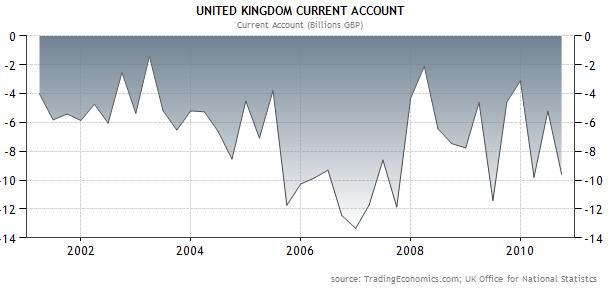
On the one hand, the UK is certainly conscious of this and would act accordingly, perhaps even delaying any foreign exchange reserve accumulation until the Pound strengthens. On the other hand, the BoE is under pressure to fight inflation. It is reluctant to raise interest rates because of the impact it would have on the fragile economic recovery. The same can be said for unwinding its asset purchases. However, if it offset this with purchases of US Treasury securities and other foreign currency assets, it could weaken the Pound and maintain some form of economic stimulus. Especially since the UK has run a sizable trade/current account deficit for as long as anyone can remember, the BoE has both the flexibility/justification it needs to coax the exchange rate down a little bit.
Ultimately, we’ll need more information before we can determine how this will impact the Pound. Still, this is an indication that the GBP/USD might not have much more room to appreciate.
Read more ....

Brazil Gets “Real” about Intervention

Brazil Gets “Real” about Intervention

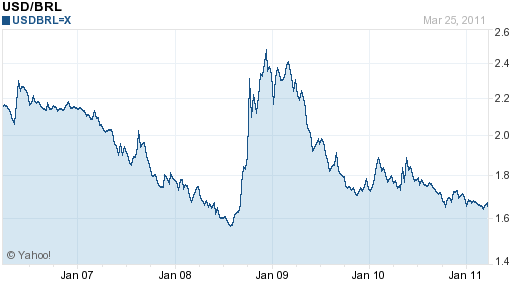
Over the last two years, the Brazilian Real has appreciated a whopping 37% against the US Dollar, second only to the South African Rand. It hasn’t been this strong since prior to the credit crisis, and it is rapidly closing in on a record high. If only Brazilian policymakers hadn’t made it a high priority to prevent that from happening.

The appreciation of the Real is being driven primarily by high interest rates, which in turn, are being driven by inflation. Brazilian prices are now rising at an annualized pace of 6%, which is well above the Bank of Brazil’s comfort zone. As a result, it has already raised rates several times in this cycle, including a 50 basis point hike at the beginning of this month. Its benchmark Selic rate now stands at a stratospheric 11.75%, which is higher than any other currency in the same tier.
Of course, the Bank of Brazil understands the implications of continuing to hike rates. With inflation as high as it is, however, it doesn’t really have much of a choice. Moreover, investors are betting on additional rate hikes, which means even wider interest rate differentials. When you also factor in a surprising lack of volatility surrounding the Real, it will certainly become an even more popular target currency for yield-hungry carry traders.
The government of Brazil, however, is doing everything in its power to repel this kind of speculation, lest it drive up the Real further and threaten the competitiveness of its export sector. In 2010, it tripled the tax rate on foreign investment in fixed income securities, to 6%. It increase scrutiny on local banks that have sought to borrow abroad. The national government has taken to doing more of its borrowing on the international market, and deposited the proceeds directly into its forex reserves, in order to mitigate the impact on the Real. The government is also contemplating punishing short-term investors by establishing a “lock-up” period for foreign capital.
And yet, Brazil finds itself in a quandary. While its trade balance has remained positive, its current account balance is now entrenched in deficit territory. Just like the US, it remaisn dependent on foreign investors to bridge this gap every month. Perennial budget deficits also mean the government can ill afford to alienate lenders. Finally, the government still wishes to attract legitimate foreign direct investment in infrastructure projects and portfolio investment in the stock market.

If Brazil is successful in limiting speculation – which is difficult, but not impossible given its determination – there is a chance that the Brazilian Real will hold steady. After all, Brazil saves less than it needs to invest, and inflation is high enough that there should be some natural downward pressure on the Real. On the other hand, if volatility remains low and speculators continue to find a way around the new capital controls (tempted by 11.75% short-term deposit rates), it will be difficult for the Central Bank to prevent its rise. It can only sit back, continue to hike rates, and pray that speculators soon lose interest.
Personally, I’m betting that the government of Brazil will achieve some measure of success, at least in the short-term. Of all the emerging-market countries engaged in the currency war, it seems to be the most resolute participant after China. At this point, short of fixing the Real to the Dollar, it has shown that it is willing to do whatever it takes to prevent speculators from winning
Read more ....